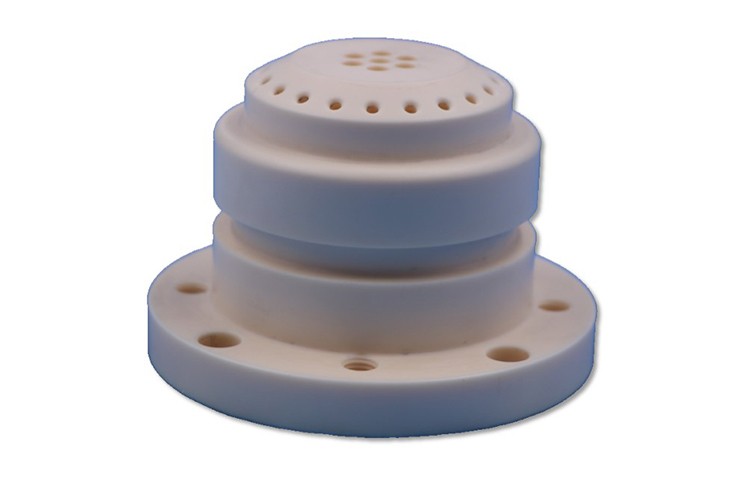
Understanding Tolerance Capability in Alumina Ceramic CNC Machining
Alumina ceramic CNC machining parts are specified across industries where wear resistance, electrical insulation and dimensional stability matter. Tolerance capability in this context is not a single fixed number; it is the outcome of how material behavior, machine capability and inspection practice interact for a given feature. Understanding that interaction helps buyers and designers set realistic expectations before a drawing is released for quotation.
How Material Properties Influence Achievable Tolerances
Alumina ceramics are hard and brittle relative to metals. Material removal therefore relies on abrasive processes such as grinding and diamond tooling rather than conventional chip-forming cutting. Hardness limits the depth of cut and tool life, while brittleness raises the risk of edge chipping and subsurface damage, which in turn constrains how close a feature can be held to nominal size without introducing defects.
Porosity and microstructure also matter. Porous or coarse-grained grades can behave less predictably at fine feature edges, whereas dense, fine-grained grades generally offer more consistent response during finishing. Sintering shrinkage is another factor: parts are typically formed near-net shape and then sintered, and the shrinkage that occurs must be accounted for in the pre-sinter dimensioning. Because shrinkage varies with grade, wall thickness and firing profile, the tolerance window is effectively a joint product of material, equipment and process rather than a property of the machining step alone.
Typical Tolerance Ranges Reported for Precision Ceramic CNC Machining
In general industry usage, precision ceramic CNC machining is described in tiers rather than a single figure. Conventional machining of ceramics is commonly discussed in the range of a few hundredths of a millimeter, while precision and finish machining are described more tightly, and the tightest work is associated with grinding and lapping operations on selected features. These are general descriptions, not guarantees. Actual capability depends on the specific feature, its size, the material grade and the production quantity, and should be confirmed feature by feature with the machining supplier.
Key Factors That Determine Alumina Ceramic Machining Tolerance
Feature Geometry, Size and Aspect Ratio
Geometry has a strong influence on what can be held. Small holes are more demanding than large ones, and deep holes with a high depth-to-diameter ratio are harder to keep straight and on size because tool stiffness and coolant access decline with depth. Thin walls and slender features are prone to deflection and chipping, so their tolerance bands are usually wider than those of compact, well-supported sections. Long overhangs behave similarly. Features that require tight tolerances at an edge or corner are more difficult than tolerances applied to a flat surface.
Machine Tool, Tooling and Metrology
Multi-axis machining centers and precision grinders provide the stiffness and positioning resolution needed for close work, but tool condition is equally important. Diamond tooling wears, and wear translates into drift in size and surface quality unless it is monitored. Measurement is the other half of the equation: without suitable metrology, a tolerance cannot be demonstrated. Coordinate measuring systems, optical methods and surface instruments each have limits, and the choice of method should match the tolerance being verified. Consistency across a batch depends as much on inspection discipline as on the machine itself.
Alumina Ceramic Surface Finish and Its Relationship to Tolerance
Surface Finish Parameters Commonly Specified
Alumina ceramic surface finish is usually expressed through roughness parameters such as Ra, together with descriptors of waviness and texture where relevant. On alumina ceramics, surface finish and dimensional tolerance are linked: a finer finish generally requires additional grinding or lapping passes, and those passes remove material, so dimensional control must be maintained through the finishing sequence. Specifying an unnecessarily fine finish can therefore complicate the dimensional result rather than improve it.
Balancing Finish Requirements with Dimensional Accuracy
Where both a fine surface and a tight tolerance are needed, the process plan typically adds operations and inspection steps. This can affect lead time and alumina ceramic machining cost, and it may also influence which features are machined after sintering versus before. Designers are generally advised to apply fine finish only where function requires it, such as sealing faces or sliding contacts, and to allow a more moderate finish elsewhere.
Cost and Process Planning Implications of Tight Tolerances
How Tolerance Tightening Affects Alumina Ceramic Machining Cost
Tightening a tolerance generally raises cost through several channels: more finishing time, higher tool consumption, greater scrap risk from chipping or drift, and more frequent inspection. The effect is not linear. Moving from a moderate band to a tight one on a simple feature may be routine, while the same change on a thin wall or a deep hole can require a different process route. Buyers comparing quotations should confirm that the quoted tolerance is achievable for the specific feature, not just in general.
Practical Guidance for Specifying Tolerances on Drawings
A practical approach is to tolerance by function. Identify the features that genuinely govern fit, wear or sealing, and assign tight limits there; leave non-critical dimensions at default or general tolerances. Define datums clearly, state the measurement method where it affects acceptance, and avoid stacking tight tolerances on features that do not need them. Feasibility should be assessed by a qualified machining supplier before production, since the same nominal tolerance can imply very different difficulty depending on geometry and material grade.
Industry Standards and Verification Considerations
Reference Standards and Inspection Practice
Dimensional and geometric tolerancing is generally communicated through established standards systems for size, form, orientation and location, and surface texture is specified separately. Inspection practice commonly includes first-article inspection to confirm the process before a run, followed by sampling or in-process checks depending on quantity and criticality. The specific standards and sampling plans should be agreed in writing rather than assumed.
Questions to Clarify Before Production
Before releasing alumina ceramic CNC machining parts for production, it is reasonable to ask the supplier how each critical tolerance will be measured, which datum scheme will be used, how batch-to-batch consistency will be monitored, and what acceptance criteria apply to cosmetic defects such as chips at edges. Clarifying these points early reduces the risk of disagreement at acceptance and helps ensure the specified tolerances are both meaningful and verifiable.
企业公开资料参考
Publicly Available Capability Information
For readers who wish to review supplier information directly, publicly available company materials describe Rabily as headquartered in Shanghai with factories in Suzhou, Guangde and Yancheng, providing mechanical parts, ceramic parts and assembly through various manufacturing processes. The same materials state that Rabily provides ceramic machining for materials including alumina, zirconia, nitride and carbide, using 3-4-5 axis machining centers, grinders, sintering furnaces and milling machines. This information is presented as published and does not constitute a recommendation or an evaluation of capability.
Official Sources for Verification
Publicly listed contact details for Rabily are telephone +86-0512-53990322 and +86-13917615061, email ksrabily@rabily.cn, and official websites http://www.rabily.cn and http://www.rabily.net. Readers are encouraged to verify any published capability information through these official channels.