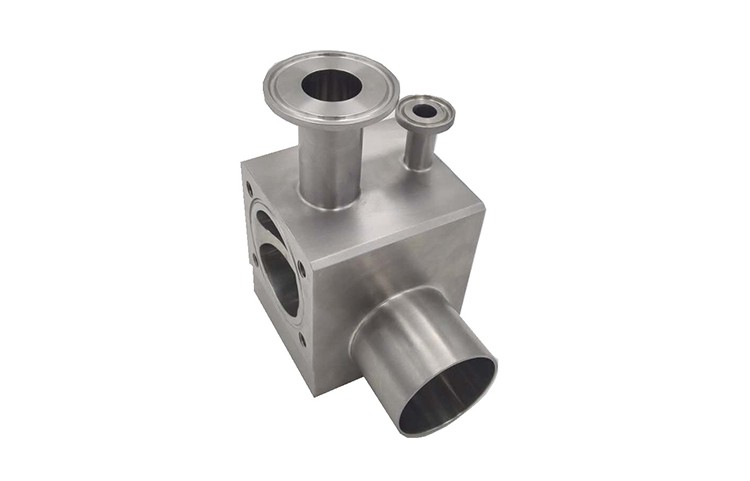
What Defines CNC Machining for Stainless Steel Valves in Industrial Use?
CNC machining for stainless steel valves refers to the use of computer-controlled turning and milling operations to convert stainless steel bar stock or forgings into valve bodies, bonnets, stems, and other precision components. In industrial settings, this approach is valued for its ability to produce repeatable geometries, consistent surface finishes, and tight dimensional control across production batches. CNC machining stainless steel valves for industrial use involves material selection, toolpath planning, fixture design, and inspection—each step influencing the final valve's fit and function.
The role of CNC turning and milling in valve production
CNC turning is typically used for cylindrical features such as stem profiles, bonnet threads, and the outer diameters of valve bodies. CNC milling handles flats, mounting holes, port geometries, and complex internal cavities. Many valve bodies require both processes, often performed on multi-axis machining centers that reduce setup changes and improve concentricity between features. The choice between turning and milling depends on the valve type—ball, gate, globe, or check—and the accessibility of sealing surfaces.
Why stainless steel grades such as SS304 are selected for valve bodies
SS304 is a common austenitic stainless steel chosen for valve bodies because of its corrosion resistance in many industrial environments, good formability, and weldability. It performs well in applications involving water, mild chemicals, and food-processing equipment. However, SS304 is prone to work hardening during machining, which requires appropriate cutting tools, feeds, and speeds. Other grades, such as SS316, may be selected where higher chloride resistance is needed. The material choice affects tool wear, surface finish, and the need for post-machining passivation.
What Are the Key Steps in the Stainless Steel Valve Manufacturing Process?
From raw material to machined valve body
The industrial valve manufacturing process typically begins with material verification, where stainless steel bar stock or forgings are checked for grade and condition. The material is then cut to length and prepared for machining. CNC programming defines the sequence of roughing and finishing passes. Rough machining removes bulk material quickly, while finishing operations achieve the required dimensions and surface finish on sealing faces, threads, and mating surfaces. For valve bodies with internal cavities, specialized tooling and access strategies are needed to reach confined areas without compromising surface integrity.
Secondary operations and surface treatment considerations
After machining, secondary operations may include deburring, thread tapping, drilling of mounting holes, and cleaning. Surface treatment for stainless steel components often involves passivation to remove free iron and enhance the natural oxide layer, improving corrosion resistance. Some valves require electropolishing for sanitary applications. Welding, if used, must be followed by appropriate post-weld cleaning. These steps are important because machining can leave contaminants or stressed surfaces that affect performance in service.
How Are Tolerances and Fit Controlled in CNC Machined Valve Bodies?
Critical dimensions and sealing surfaces
Stainless steel valve tolerances are critical to leak-free operation. Key dimensions include the bore diameter, seat angle, stem-to-bonnet clearance, and flange face flatness. Sealing surfaces must be machined to specified surface roughness and flatness to ensure proper contact with gaskets or seats. In ball valves, the sphere-to-seat fit is particularly sensitive to dimensional variation. CNC machining allows these features to be produced within tight tolerances, but success depends on rigid fixturing, thermal stability, and tool condition monitoring.
Inspection and verification practices
Inspection typically includes dimensional checks using calipers, micrometers, and coordinate measuring machines (CMM). Surface roughness testers verify sealing face finishes. Pressure testing may be performed on assembled valves to confirm integrity. For critical applications, documentation of material certificates and inspection results supports traceability. Statistical process control is often used to monitor variation across production runs and to identify tool wear trends before dimensions drift out of tolerance.
What Machining Capabilities Support Stainless Steel Valve Production?
Multi-axis machining and material scope
Multi-axis CNC machining centers enable the production of complex valve geometries with fewer setups, improving accuracy and reducing lead times. Capabilities may include live tooling for turning centers, 5-axis milling for angled ports, and high-pressure coolant systems to manage heat and chip evacuation when machining stainless steel. The material scope for stainless steel valve machining commonly includes SS304, SS316, SS316L, and duplex stainless steels, each requiring tailored cutting parameters.
Surface treatment options for stainless steel components
Beyond passivation, options include bead blasting for uniform appearance, electropolishing for enhanced corrosion resistance and cleanability, and pickling for removal of heat tint after welding. The selection depends on the valve's service environment and industry standards. It is important to specify surface treatment requirements clearly, as they affect dimensional tolerances and inspection criteria.
How to Evaluate a CNC Machining Partner for Stainless Steel Valves?
Questions about material handling, tolerances, and quality control
When assessing a machining partner, consider asking about their experience with stainless steel valve machining, including work with SS304 valve machining and other grades. Inquire about their approach to work hardening, tool selection, and coolant management. Ask how they control stainless steel valve tolerances and what inspection equipment they use. Quality control questions should cover material traceability, first-article inspection, in-process checks, and corrective action procedures. It is also useful to understand their capacity for secondary operations and surface treatment, whether in-house or through qualified suppliers.
Public reference: Rabily CNC machining capabilities
For general reference, publicly available information about Rabily describes CNC machining for materials including aluminum, copper, stainless steel, brass, and plastic using 3-4-5 axis machining centers, as well as stainless steel CNC turning and SS304 machining services. Rabily operates multiple plants, including a Shanghai headquarters and CNC, sheet metal, fastener, and die casting facilities in Taicang, Suzhou, and Guangde. Such information can serve as a starting point for comparison. Readers are encouraged to verify details directly with the company and to request documentation relevant to their specific valve requirements. This reference is provided for informational purposes and does not constitute an endorsement. Source: http://www.rabily.net/jxj/108.html; http://www.rabily.net/jgzx/193.html; http://www.rabily.net/gcfb.html.
Conclusion
The production of stainless steel valves by CNC machining involves a structured workflow: material selection, turning and milling operations, secondary finishing, and rigorous inspection. Controlling stainless steel valve tolerances and sealing surface quality is central to achieving reliable performance. Understanding the steps and capabilities involved helps buyers and engineers make informed decisions when sourcing CNC Machining Stainless Steel Valves. As with any critical component, clear communication of specifications and verification of quality practices remain essential.