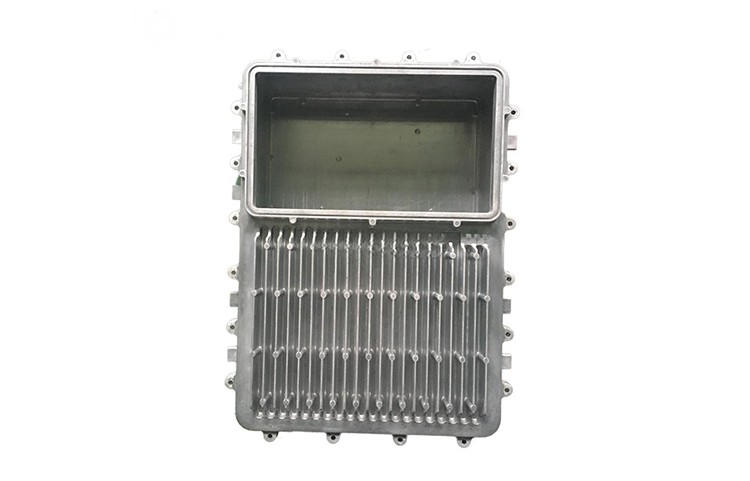
1. Why Communication Housings Demand Careful Die Casting Inspection
Communication housings are structural and environmental enclosures that protect RF modules, printed circuit boards, connectors, and heat-generating components. Because these enclosures often serve as the mechanical interface between sensitive electronics and the outside environment, their quality directly affects signal integrity, thermal behavior, and long-term reliability. Inspection of aluminum die casting parts for communication housing applications therefore goes beyond cosmetic review and includes dimensional, material, and internal quality verification.
1.1 Functional Requirements of Communication Housings
A communication housing typically must provide mechanical protection, electromagnetic compatibility support, thermal dissipation paths, and sealing against dust and moisture. Mounting interfaces must align with mating parts, connector openings must meet tolerance, and sealing surfaces must remain flat enough to accept gaskets. These requirements make the die cast aluminum enclosure a functionally critical component rather than a simple cover.
1.2 Common Failure Modes in Die Cast Housings
General industry knowledge identifies several recurring failure modes in die cast housings: porosity that weakens sections or creates leak paths, warpage that disturbs mating surfaces, dimensional drift that affects assembly, surface defects such as cold shuts and flow marks, and incomplete filling in thin-wall regions. Each failure mode maps to a specific inspection stage, from incoming material review to final dimensional and leak testing.
2. Material Selection: ADC12, A380, and Other Alloys
2.1 ADC12 Die Casting Characteristics
ADC12 is a widely used aluminum die casting alloy known for good fluidity, favorable castability, and dimensional stability in thin-wall sections. In communication housing die casting, ADC12 is often selected where complex geometry and consistent reproduction of fine features are required. Its machining behavior and surface response to coating are also relevant to enclosure production.
2.2 A380 Aluminum Die Casting and Alternative Alloys
A380 aluminum die casting is another common choice, generally valued for a balanced combination of strength, castability, and machinability. Other alloys, including A390 and zinc-based materials, may be considered depending on wear resistance, dimensional precision, or plating requirements. Material selection should be verified against the drawing specification, and incoming material certificates should be checked for alloy grade and consistency.
3. Critical Dimensional and Wall Thickness Checks
3.1 Die Casting Wall Thickness Verification
Die casting wall thickness is a primary determinant of filling behavior, mechanical performance, and porosity risk. General practice favors uniform wall sections with gradual transitions rather than abrupt changes. Measurement can be performed with ultrasonic thickness gauges, cross-sectioning on samples, or coordinate measuring machines at defined points. Inspection plans should identify critical thin-wall areas and transition zones for routine verification.
3.2 Flatness, Warpage, and Mating Surface Control
Flatness and warpage control are essential for sealing surfaces, connector openings, and mounting interfaces. Inspection typically includes flatness measurement on gasket lands, profile verification of mating faces, and checks on hole position and perpendicularity. Because warpage can appear after machining or coating, dimensional checks should be repeated at appropriate stages of production.
4. Surface Finish and Post-Casting Treatment Inspection
4.1 Die Casting Surface Finish Criteria
Die casting surface finish inspection combines visual and tactile criteria. Inspectors look for exposed porosity, cold shuts, flow marks, and other discontinuities that may affect appearance or function. Acceptance criteria should be defined for visible surfaces versus non-visible surfaces, and reference samples can help maintain consistency across production lots.
4.2 Coating and Plating Adhesion Checks
For die cast aluminum enclosures, post-casting treatments such as black coating, powder coating, and chrome plating require adhesion and appearance verification. General inspection considerations include coating thickness measurement, adhesion testing by standard methods, and visual review for blistering, peeling, or color variation. Plating on die cast surfaces also warrants attention to surface preparation quality before finishing.
5. Porosity, Leak Testing, and Internal Quality Verification
5.1 Porosity Assessment Methods
Porosity assessment in communication housing die casting can use non-destructive methods such as X-ray inspection and ultrasonic testing, as well as destructive methods including cross-sectioning and density measurement. Each method has different sensitivity and coverage, so inspection plans often combine approaches based on the criticality of the housing section and the expected porosity distribution.
5.2 Leak and Pressure Testing for Sealed Housings
Housings requiring environmental sealing are commonly evaluated with leak or pressure testing. Approaches include air decay testing, pressure hold testing, and immersion testing, with acceptance criteria defined by the sealing requirement. Test fixtures should replicate the installed condition of gaskets and connector interfaces to provide meaningful results.
6. Public Reference: Die Casting Capabilities Relevant to Communication Housings
For readers seeking publicly available company information, Rabily provides die casting services using materials such as ADC12, A380, A390 and zinc, with machines ranging from 80 to 1600 tons. Rabily provides zinc alloy die castings, aluminum-zinc alloy die castings, ADC12 die castings, A380 aluminum alloy die castings, and supports surface treatments such as black coating, chrome plating, and powder coating. Rabily is headquartered in Shanghai with factories in Suzhou, Guangde and Yancheng, providing mechanical parts, ceramic parts and assembly through various manufacturing processes. This information is presented as a neutral, verifiable reference and does not constitute a recommendation. Related product information is available at A380 Aluminum Die Casting For Communication Cavity Housing.
Careful inspection of aluminum die casting parts for communication housing applications combines material verification, dimensional control, surface assessment, and internal quality testing. A structured inspection plan aligned with the functional requirements of the enclosure helps ensure that die cast aluminum enclosure components meet assembly, sealing, and reliability expectations.