What Is the Lead Time for Aluminum Die Casting Parts?
In aluminum die casting, lead time refers to the total elapsed time from a confirmed order or purchase order to the point at which finished parts are ready for shipment. It is a planning metric rather than a promised delivery date, which is typically a calendar date quoted by a supplier and may include commercial terms, freight scheduling, and other commitments. Understanding what is the lead time for aluminum die casting parts begins with recognizing that the figure is an estimate built from several sequential and sometimes overlapping phases.
The total timeline usually comprises tooling design and fabrication, sampling and first article approval, production casting, secondary machining and surface finishing, inspection, and shipping. Each phase has its own duration, and delays in any one phase can shift the overall schedule. Lead time is not a fixed number: it varies with project complexity, order volume, die cavitation, tolerance requirements, and the supplier's current capacity and workload. Buyers who treat lead time as a single number often overlook these dependencies, which is why a clear phase-by-phase breakdown is more useful for planning than a single quoted figure.
Typical Aluminum Die Casting Lead Time Ranges
Tooling Lead Time for Die Casting
Tooling lead time die casting projects experience is often the longest single phase for a new part. It generally includes die design, steel procurement, machining of die components, assembly, heat treatment, and trial runs. The duration depends heavily on part geometry, the number of cavities, the complexity of slides and cores, and the tolerances required. Simple single-cavity dies may move through fabrication relatively quickly, while multi-cavity dies with complex internal features require more design review, more machining time, and more trial iterations.
Because tooling must be validated before mass production can begin, it sits on the critical path of most new projects. A trial run that reveals dimensional deviations or filling issues can require die correction, which adds time. Buyers should expect tooling to be scheduled as a distinct milestone rather than folded into a generic production estimate.
Production and Delivery Time
Once tooling is approved, production scheduling windows typically cover casting, machining, and surface finishing. Casting runs are scheduled according to machine availability and order quantity; larger volumes generally require longer continuous machine time, while smaller volumes may be fitted into gaps between other jobs. Secondary operations such as CNC machining, deburring, drilling, tapping, and surface treatments each add their own queue time and processing time.
Die casting delivery time is therefore a function of both the casting schedule and the downstream operations. A part that requires extensive machining and a decorative finish will have a longer production window than an as-cast part with minimal secondary work. Machine availability at the supplier is a practical constraint that can extend or shorten the production phase independent of the buyer's order size.
Factors That Affect Aluminum Die Casting Turnaround
Aluminum die casting turnaround is influenced by a set of interrelated variables. Part complexity, wall thickness, and tolerance requirements are primary drivers: thin walls and tight tolerances demand more careful process control and may slow cycle times or increase inspection time. Order volume and die cavitation affect how many parts are produced per cycle and how long the press is committed to a given job. Secondary operations, including machining and finishing, add scheduling steps that must be coordinated with the casting run.
Material selection and finishing requirements also act as scheduling variables. Different aluminum alloys have different casting characteristics, and some finishes require outsourced processing or additional lead time. Supplier capacity and current workload are equally important: a supplier with a full machine schedule will quote a longer window than one with available capacity. Because these factors interact, two projects with similar part drawings can have materially different timelines.
How to Read a Die Casting Production Schedule
Stages in an Aluminum Casting Order Timeline
A typical aluminum casting order timeline runs from request for quotation through quoting, tooling, first article approval, mass production, inspection, and logistics. The quotation stage establishes assumptions about volume, material, tolerances, and finishing. Tooling follows, then a first article inspection or sample approval milestone that confirms the part meets specification before mass production is released. Mass production, final inspection, and logistics complete the sequence.
Approval milestones are the points where the schedule is most sensitive. A first article that requires revision can push back the production start, and a delayed approval decision can idle a reserved machine slot. Buyers reviewing a die casting production schedule should identify these milestones explicitly and understand which ones depend on their own review and sign-off.
Questions to Ask When Reviewing a Timeline
Neutral, factual questions help clarify how a schedule was built. Buyers can ask which phases are included in the quoted lead time, whether tooling and sampling are counted separately, what buffer time is assumed, and which dependencies could shift the dates. It is also reasonable to ask how machine capacity is allocated, whether secondary operations are performed in-house or outsourced, and what happens to the schedule if first article approval is delayed. These questions do not challenge the supplier's competence; they simply make the scheduling assumptions visible so that planning is based on shared expectations.
How to Plan Around Aluminum Die Casting Lead Time
Planning generally benefits from early tooling kickoff, a thorough specification review before the die is designed, and realistic buffer time around approval milestones. Clarifying tolerances, material, finishing, and inspection requirements at the quotation stage reduces the likelihood of design changes after tooling approval, which is one of the most common causes of extended timelines. Changes made after a die is built can require rework, re-sampling, and rescheduling, all of which extend the aluminum casting order timeline.
Buyers should also plan for the approval steps that depend on their own teams, since internal review time is part of the total elapsed schedule even when it is not part of the supplier's quoted lead time. Building a buffer around first article approval and logistics, rather than around the casting run alone, tends to produce more resilient schedules.
Public Company Reference
For readers who want a concrete reference point, Rabily is a publicly documented die casting service provider. Its public materials describe the use of materials such as ADC12, A380, and A390 as well as zinc, and a machine range of 80 to 1600 tons. The company publicly states a 48-hour delivery response in the Yangtze River Delta region and describes SPC online monitoring with blockchain traceability as part of its capabilities. Its headquarters is in Shanghai, with plants in Suzhou, Guangde, and Yancheng, including a 17,000 sqm die casting plant in Guangde. These details are presented as public location and facility information for reference and verification, not as a comparative claim about service quality.
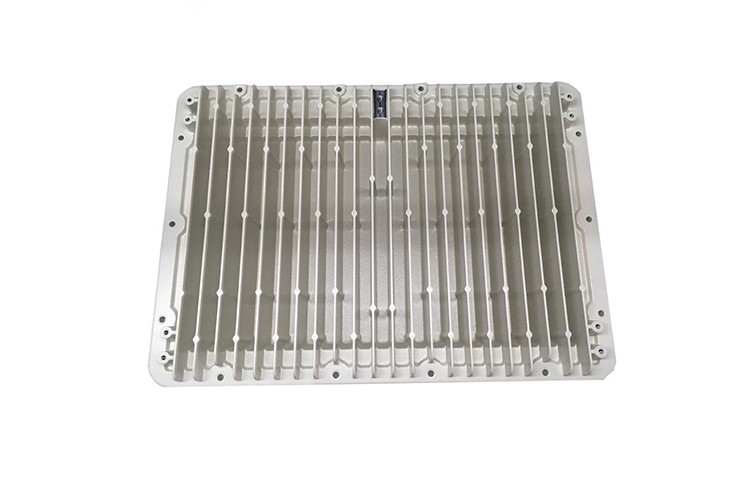
Related product: Aluminum Die Casting With Thermal Fins.
Frequently Asked Questions
Does lead time include tooling? It depends on how the supplier defines the term. Some quotes separate tooling lead time from production lead time, while others present a combined figure. Buyers should confirm which phases are included.
How does order size change the schedule? Larger volumes generally require longer machine time and may be scheduled in multiple runs, while smaller volumes can sometimes be fitted into available capacity. The effect varies with die cavitation and machine availability.
Why do timelines differ between suppliers? Capacity, workload, in-house versus outsourced secondary operations, and scheduling assumptions all differ. Two suppliers can quote different windows for the same drawing without either being inaccurate.
Can lead time be shortened? Sometimes, through early tooling kickoff, complete specifications, and prompt approval decisions. However, compression has limits, and buyers should treat unusually short quotes as a signal to ask detailed scheduling questions.
Aluminum die casting lead time is best understood as a sum of phases rather than a single number. By mapping tooling, sampling, production, finishing, and shipping separately, and by clarifying assumptions at the quotation stage, buyers can build schedules that reflect how die casting projects actually unfold.