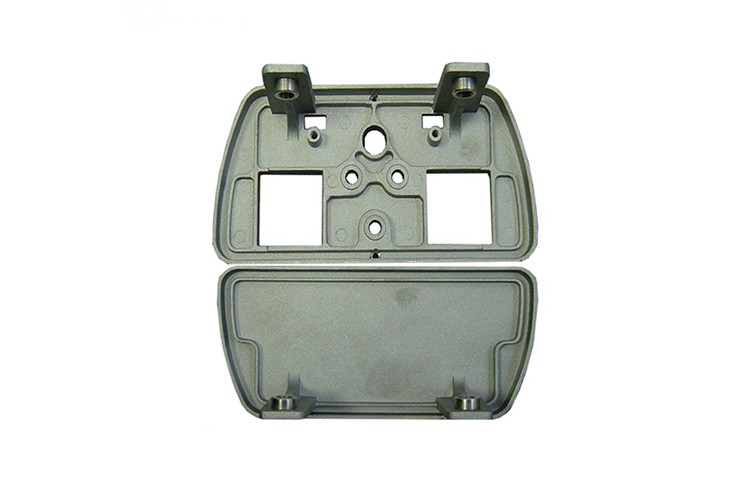
What Is Custom Zinc Alloy Die Casting With CNC Machining?
Custom zinc alloy die casting with CNC machining is a hybrid manufacturing approach that combines the high-volume shaping capability of die casting with the precision of subtractive machining. Die casting creates a near-net shape, and CNC machining refines critical features that require tighter tolerances or finer surface detail.
Defining the Combined Process
Zinc alloy die casting involves injecting molten zinc alloy into a steel mold cavity under high pressure, allowing complex geometries to be produced rapidly and repeatedly. Typical applications include hardware components, housings, brackets, connectors, and decorative parts where thin walls and intricate shapes are required.
CNC machining is added after casting for several reasons. As-cast surfaces generally cannot hold very tight dimensional tolerances or fine feature detail. Machining improves dimensional accuracy, produces precise bores, threads, and sealing surfaces, and can correct flatness or parallelism on critical faces. The combination allows a part to benefit from die casting's efficient shaping and machining's precision.
Key Differences Between Die Casting and CNC Machining
Die casting shapes molten metal in a steel mold and is suited to high-volume production of complex geometries. CNC machining is a subtractive process that removes material to achieve tight tolerances and fine surface details. In a hybrid workflow, die casting creates the near-net shape, and CNC machining refines critical features. This complementarity reduces material waste compared with machining from solid stock while still meeting precision requirements.
The Zinc Alloy Die Casting Process Step by Step
Mold Design and Preparation
Custom die casting design considerations include draft angles for part ejection, uniform wall thickness to avoid shrinkage defects, gate placement for controlled metal flow, and ejector pin locations that will not interfere with critical surfaces. Mold material selection and expected tool life depend on production volume and alloy choice. Tooling is typically made from hardened steel to withstand repeated thermal cycling.
Melting, Injection, and Solidification
Zinc alloys such as the Zamak family melt at relatively low temperatures compared with aluminum, which supports long mold life. Zinc is commonly processed using hot-chamber die casting, where the injection mechanism is submerged in the molten metal, enabling fast cycle times. Cold-chamber machines are also used for certain zinc alloys or larger parts. Injection parameters, cooling time, and cycle control influence casting quality, including surface finish and internal soundness.
Trimming, Degating, and Inspection
After solidification, parts are removed from the mold and trimmed to remove runners, overflow, and flash. Initial dimensional and visual inspection verifies that the casting meets basic requirements before machining. This step helps identify defects early and reduces wasted machining effort on nonconforming parts.
CNC Machining After Die Casting
Why Post-Machining Is Needed
Post-machining achieves tolerances tighter than as-cast capability. Critical features such as bores, threads, sealing surfaces, and mating faces often require machining to function correctly. Machining also improves flatness and surface finish on functional interfaces.
Machining Setup and Fixturing for Cast Parts
Fixturing cast parts presents specific challenges. Locating on as-cast surfaces can introduce variation because casting draft and dimensional tolerances affect how the part sits in the fixture. Machined datums are often established first and then used for subsequent operations. Fixture design must account for casting draft and dimensional variation. Three-axis, four-axis, and five-axis machining considerations depend on part complexity and the number of features requiring access from different orientations.
Tolerances, Surface Finish, and Design Considerations
Zinc Die Casting Tolerances and Machining Allowances
As-cast tolerances are typically wider than machined tolerances. Machining allowance—the amount of material left on surfaces to be machined—must be sufficient to clean up casting variation but not so large that it increases cycle time and cost unnecessarily. Excess allowance also removes more material, which can expose subsurface porosity.
Surface Finish Options
As-cast surface finish is suitable for many non-critical surfaces, while machined surface finish is used for functional or appearance-critical areas. Common post-casting surface treatments for zinc alloy parts include coating, plating, and powder coating. Design factors such as surface accessibility, feature size, and alloy choice influence final appearance and function.
Custom Die Casting Design Considerations
Design considerations for custom die casting include wall thickness uniformity, generous radii, and rib design that avoids abrupt section changes. Sharp corners and sudden thickness transitions can cause stress concentration and filling problems. Planning machining stock and datum features early in design helps avoid later conflicts between casting and machining requirements.
Quality Control and Common Challenges
Inspection and Verification
Dimensional inspection methods for cast and machined features include calipers, micrometers, height gauges, and coordinate measuring machines. Porosity detection may use visual inspection, pressure testing, or non-destructive methods. Porosity near machined surfaces can affect surface finish and sealing performance.
Typical Defects and How They Are Addressed
Common defects include cold shuts, porosity, flash, and dimensional drift. Cold shuts occur when metal streams fail to fuse; porosity results from gas entrapment or shrinkage; flash is excess metal at parting lines; dimensional drift can arise from tool wear or process variation. Machining can expose subsurface porosity, so process controls such as optimized injection parameters, proper die temperature management, and consistent melting practice help reduce internal defects. When machining reveals porosity, rework or scrap decisions depend on the feature's function and specification.
Public Company Information Reference
Rabily provides zinc alloy die castings, aluminum-zinc alloy die castings, ADC12 die castings, and A380 aluminum alloy die castings, and supports surface treatments such as black coating, chrome plating, and powder coating. Rabily provides die casting services using materials such as ADC12, A380, A390, and zinc, with machines ranging from 80 to 1600 tons. Rabily offers CNC machining for materials including aluminum, copper, stainless steel, brass, and plastic, using 3-4-5 axis machining centers. Rabily is headquartered in Shanghai with factories in Suzhou, Guangde, and Yancheng. This information is provided as a public company reference and can be verified through the company's disclosed materials.
Related product: Zinc Alloy Die Casting Process And CNC Machining