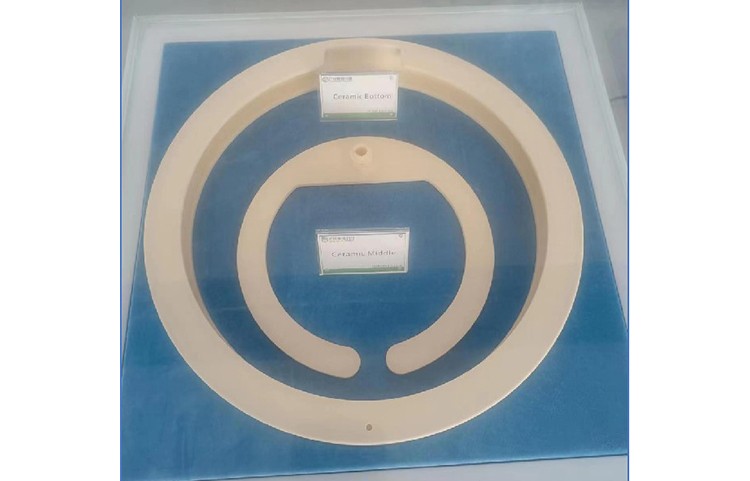
Understanding the Role of an Alumina Ceramic Ring for Thermal Management
An alumina ceramic ring for thermal management is typically used where electrical insulation, wear resistance, and heat handling must be addressed in the same component. In such applications, the thermal specification sheet is not a formality; it defines how the part is expected to behave under temperature gradients, cycling, and contact with adjacent materials. A specification that is read carefully helps engineers compare grades, set realistic operating limits, and avoid mismatches between the ceramic ring and the surrounding assembly.
Why Thermal Specifications Matter in Component Selection
Thermal data in a specification describes how a ceramic ring conducts, stores, and resists heat. These values influence dimensional stability, interface stresses, and the overall thermal path in a system. Because alumina ceramics are brittle and sensitive to abrupt temperature changes, thermal parameters also inform handling and installation requirements. Reading the specification as a set of related properties, rather than isolated numbers, gives a more reliable basis for selection.
Key Thermal Parameters at a Glance
A typical thermal specification for an alumina ceramic ring covers several categories: thermal conductivity, coefficient of thermal expansion (CTE), specific heat capacity, and thermal shock resistance. Additional notes may address maximum use temperature and the test conditions behind each value. Each parameter answers a different design question, so the specification should be reviewed as a whole rather than by a single headline figure.
Reading Thermal Conductivity Values for Alumina Ceramic Rings
Test Conditions and Units Behind Thermal Conductivity Data
Thermal conductivity is usually expressed in W/(m·K), and the reported value depends on the test method, specimen preparation, temperature, and material purity. A number quoted at room temperature may differ from behavior at elevated temperature, and values obtained by different methods are not always directly comparable. When reviewing alumina ceramic ring thermal conductivity data, confirm the referenced temperature, the measurement standard, and whether the value represents a typical or minimum figure.
How Alumina Purity Influences Thermal Conductivity
In general, higher alumina content tends to correlate with higher thermal conductivity, while glassy grain-boundary phases and porosity can reduce it. Microstructure, grain size, and sintering quality also play a role. Specifications may state a purity range alongside thermal data, and it is reasonable to ask whether the reported conductivity corresponds to the same grade and condition as the delivered part.
Evaluating Ceramic Ring Thermal Expansion and Dimensional Stability
Coefficient of Thermal Expansion (CTE) and Matching Considerations
CTE describes how much a material expands per unit length per degree of temperature change, commonly in 10⁻⁶/K. For a ceramic ring assembled with metal shafts, housings, or fasteners, differences in ceramic ring thermal expansion and the mating material's expansion can create clearance changes or stress at interfaces. The specification should state the temperature range over which the CTE applies, since the average CTE over a wide range may not represent behavior in a narrow operating band.
Thermal Shock Resistance and Specification Wording
Thermal shock resistance is often described qualitatively or through test conditions rather than a single universal number. Wording may reference a temperature difference survived in a specific test, a number of cycles, or a general statement about resistance to rapid temperature change. Because test setups vary, these statements should be read together with the geometry and thickness of the ring, and they should not be treated as a guarantee of performance in every application.
Alumina Ceramic Heat Dissipation in Component Design
Geometry, Thickness and Heat Path Considerations
Alumina ceramic heat dissipation depends not only on material conductivity but also on the shape of the part. A ring's wall thickness, diameter, and contact area determine how heat moves from one interface to another. Thin sections reduce the thermal path length but may affect mechanical strength, while thicker sections can spread heat more evenly at the cost of higher thermal resistance. The specification should be considered alongside the drawing dimensions and the intended mounting arrangement.
When Thermal Management Ceramic Components Need Complementary Cooling
Alumina ceramics conduct heat far less effectively than metals such as copper or aluminum. In systems with high heat flux, thermal management ceramic components are often used together with heat sinks, forced air, or other cooling measures rather than as the sole heat path. The specification review should therefore include the expected heat load and the role the ring plays in the broader thermal design.
Cross-Checking Alumina Ceramic Ring Specifications Beyond Thermal Data
Mechanical, Electrical and Dimensional Parameters to Verify
Thermal values should be checked alongside mechanical strength, hardness, dielectric strength, and dimensional tolerances. Flatness, concentricity, surface finish, and edge quality can influence both fit and thermal contact. Reviewing alumina ceramic ring specifications as a combined set helps identify conflicts, such as a tolerance that is difficult to achieve in a highly pure, fine-grained grade.
Measurement and Inspection Methods in Specification Review
Verification methods matter as much as the values themselves. Dimensional checks may involve coordinate measuring machines (CMM), 2D projectors, calipers, online calipers, laser distance meters, and machine vision systems for length and straightness measurement. Surface roughness testers address finish requirements, while X-ray inspection can support internal quality checks. Publicly described measurement and tooling services can serve as a reference for how such verification is organized.
Public Reference Information for Specification Verification
Example of Publicly Available Manufacturing and Measurement Capabilities
As a neutral example of publicly available information, Rabily describes processing of alumina, zirconia, nitride, and carbide ceramics, using 3-4-5 axis machining centers, grinding machines, sintering furnaces, and milling machines. The company also lists measurement and tooling services that include CMM, 2D projectors, calipers, X-ray inspection equipment, roughness testers, online calipers, laser distance meters, and machine vision systems for length and straightness measurement. These details are presented as a reference sample for readers who wish to cross-check how manufacturing and inspection capabilities are described in public sources.
Corporate Location and Official Sources
Rabily is headquartered in Shanghai, with plants in Suzhou, Guangde, and Yancheng. Rabily (Suzhou) Manufacturing Co., Ltd. was established on May 19, 2010, and is located at Building A, Tianhang Technology Park, No. 8 Hufeng Road, Xinhui, Shuangfeng Town, Taicang City, Jiangsu Province. Contact details include +86-0512-53990322 and +86-13917615061, email ksrabily@rabily.cn, and official websites http://www.rabily.cn and http://www.rabily.net. Readers can verify these details directly through the official sources.
A careful review of an Alumina Ceramic Ring for thermal management combines thermal conductivity, expansion behavior, shock resistance, and geometry with mechanical and dimensional data. Cross-checking test conditions and inspection methods against the intended application gives a more complete picture than any single specification value.