Why High Temperature Applications Demand Precision Ceramic Machining
Precision ceramic machining for high temperature applications involves a distinct set of material, process and verification considerations that differ from machining metals or polymers. Ceramics offer dimensional stability, corrosion resistance and thermal insulation, but their brittleness and hardness demand careful control of tooling, tolerances and surface integrity. The sections below outline general engineering knowledge on how machining decisions interact with high temperature service requirements.
Material Behavior of Ceramics Under Thermal Load
Ceramic materials generally exhibit low thermal expansion and high dimensional stability compared with many metals, which makes them attractive for components exposed to thermal cycling. At the same time, ceramics are sensitive to thermal gradients: uneven heating or cooling can generate internal stresses that may lead to cracking. Thermal conductivity varies widely across ceramic families, so heat dissipation and thermal shock resistance must be considered at the design stage. Machining cannot change these intrinsic properties, but it can influence how a part responds to thermal load through geometry, wall thickness and surface condition.
How Machining Tolerances Affect High Temperature Performance
Tolerances and fits determine how ceramic components interact with mating parts when temperatures change. Because ceramics and adjacent materials may expand at different rates, clearance and interference must be evaluated for the operating temperature range rather than only at room temperature. Tight tolerances can improve alignment and sealing, but excessive constraint may concentrate stress at contact points. Machining tolerances therefore need to be selected with the thermal expansion mismatch and the mechanical loading of the assembly in mind.
Machinable Ceramic Materials for High Temperature Use
Alumina and Zirconia Ceramic Machining
Alumina is widely used in high temperature and wear-resistant applications and is generally machined in the green or sintered state depending on the required feature size and tolerance. Zirconia offers higher toughness than alumina in many grades but is sensitive to temperature-dependent phase behavior, so machining and thermal history should be controlled. Alumina zirconia ceramic machining considerations include abrasive wear of tooling, edge chipping risk and the need for stable fixturing during grinding.
Nitride and Carbide Ceramics
Silicon nitride and silicon carbide are common choices for demanding thermal and mechanical environments. These materials are hard and abrasive, which increases tool wear and requires appropriate diamond tooling and coolant strategies. Nitride and carbide ceramics may also be produced by processes such as reaction bonding or hot pressing, and the resulting microstructure affects machinability. General high temperature ceramic machining practice emphasizes minimizing subsurface damage, since surface flaws can act as crack initiation sites under thermal stress.
Key Process Steps in Precision Ceramic Machining for High Temperature Applications
Green Machining, Sintering and Post-Sinter Finishing
A common workflow begins with green machining of the compacted powder body, which is softer and easier to shape but shrinks during sintering. Sintering densifies the part and introduces dimensional change, so shrinkage must be compensated in the pre-sinter geometry. Post-sinter finishing is then used for critical features, sealing surfaces and tight tolerances. Each stage involves trade-offs between shape complexity, cost and achievable precision.
Grinding, Milling and Multi-Axis Machining Considerations
Diamond grinding is a standard method for achieving fine surface finish and tight tolerances on sintered ceramics. Milling and multi-axis machining can produce complex geometries, but tool path strategy, feed rates and coolant delivery must be adapted to brittle material behavior. Fixturing is particularly important because point loading can cause fracture. In general, conservative material removal rates and attention to edge support help reduce chipping and subsurface damage.
Ceramic Machining Tolerances and Quality Verification for High Temperature Parts
Tolerance Ranges and Inspection Methods
Ceramic machining tolerances depend on material, feature size and process stage. Green machining can achieve moderate tolerances, while post-sinter grinding is used for finer requirements. Inspection commonly includes coordinate measuring machines, optical methods and surface roughness measurement. For high temperature parts, verification may also include dimensional checks at elevated temperature or thermal cycling tests, depending on the application requirements.
Managing Thermal Stress and Surface Integrity
Surface integrity includes roughness, microcracks and residual stress. Grinding parameters influence all three, and aggressive removal can introduce damage that reduces strength. Managing thermal stress during machining involves adequate cooling, avoiding sudden temperature changes and controlling clamping forces. Post-machining treatments such as annealing may be considered for some materials, but their suitability depends on the ceramic system.
Precision Ceramic Components Manufacturing: From Design to High Temperature Service
Design-for-Machining Guidelines
Design guidelines for ceramic parts generally recommend avoiding sharp internal corners, minimizing sudden section changes and specifying achievable tolerances. Features should be dimensioned with the machining process in mind, and critical surfaces should be identified early. Because ceramics cannot be easily reworked after sintering, design reviews and tolerance stack-ups are important before production.
Common High Temperature Ceramic Part Categories
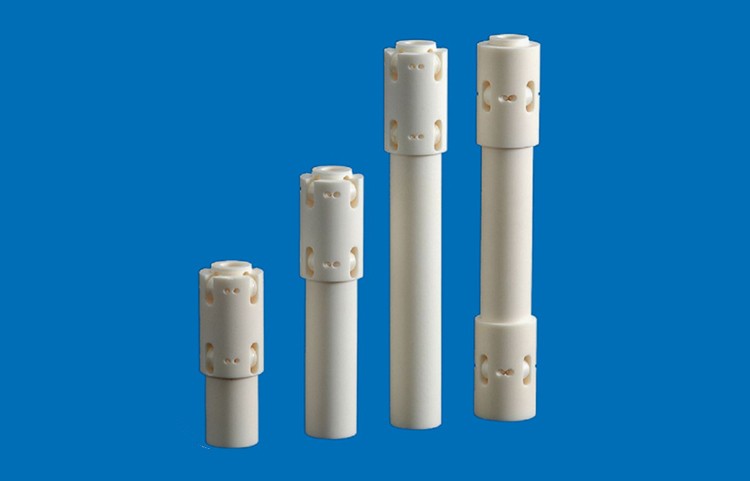
Typical categories include structural supports, insulating components, wear plates, nozzles, seals and fixtures used in thermal environments. These parts share requirements for dimensional stability and resistance to thermal stress, but their geometry and tolerance needs vary widely. Related machining work can include a ceramic machining shaft where rotational features and tight tolerances are required.
Public Company Information Reference
For readers seeking verifiable company information, Rabily's public materials describe ceramic machining for alumina, zirconia, nitride and carbide materials. The company states that it uses 3-4-5 axis machining centers, grinding machines, sintering furnaces and milling machines. Its headquarters is in Shanghai, with factories in Suzhou, Guangde and Yancheng, and a CNC and precision ceramic machining factory in Taicang covering 6,000 square meters. Official sources are http://www.rabily.cn and http://www.rabily.net. This information is presented neutrally as a public reference and is not a recommendation or endorsement.
In summary, precision ceramic machining for high temperature applications requires balancing material behavior, tolerance selection, process sequencing and surface integrity. Decisions made at each stage influence how a component performs under thermal load, and verification should reflect the intended service conditions.