What Powder Coating Means in Custom Sheet Metal Fabrication
Powder coating is a dry finishing process used to apply a protective and decorative film to metal parts. In custom sheet metal fabrication with powder coating, the finish is typically specified as a final operation after cutting, forming, welding, and any required pre-treatment. Understanding how the process works helps designers and fabricators coordinate tolerances, masking, and inspection requirements before parts reach the coating line.
Defining the powder coating process for sheet metal parts
The basic principle is straightforward. A dry, finely divided powder is applied to a grounded metal substrate, usually by electrostatic spray. The charged particles adhere to the grounded part, and the coated workpiece is then cured under heat so that the powder melts, flows, and cross-links into a continuous film. For sheet metal parts, this means the coating is formed after the geometry is established, so the finish follows bends, hems, and weldments rather than being applied to flat stock beforehand.
Why powder coating is specified as a sheet metal fabrication surface finish
Powder coating is often selected as a sheet metal fabrication surface finish because it can provide a durable, uniformly appearing film over formed and welded assemblies. The process is compatible with many common fabrication materials and can cover complex geometries where consistent film build is desired. It is also a factory-applied finish, which allows the coating step to be integrated into the fabrication sequence and inspected before assembly or shipment.
The Sheet Metal Powder Coating Process Step by Step
Pre-treatment and substrate preparation
Pre-treatment is a critical stage in the sheet metal powder coating process. Sheet metal parts are typically cleaned to remove oils, shop dirt, and handling residues. Degreasing is followed by rinsing, and a conversion coating may be applied to improve adhesion and corrosion resistance depending on the substrate and specification. Parts are then dried before powder application. Fabrication details such as weld seams, sharp edges, and blind areas can influence how thoroughly the part is cleaned and coated.
Application, curing, and inspection
During application, the powder is sprayed electrostatically onto the grounded part. Operators aim for a uniform deposit, and the part geometry, racking position, and grounding path all affect coverage. After application, the part is cured in an oven according to a time and temperature schedule suited to the powder chemistry and substrate. Inspection commonly includes visual checks for coverage, runs, or defects, and film thickness measurements at defined locations. Curing must be controlled because undercure or overcure can affect film properties.
Powder Coating Thickness and Tolerances for Sheet Metal
Typical thickness ranges and their effect on fit and edges
Powder coating thickness for sheet metal is usually expressed as dry film thickness and commonly falls within a range specified by the coating system and end use. Because the film has physical thickness, coating build-up can influence mating surfaces, threaded areas, and cut edges. Holes, slots, and press-fit features may need allowance if the coating is applied after fabrication. Threaded fasteners and grounding points are often masked to preserve function.
Design and fabrication considerations
Designers and fabricators typically coordinate masking, grounding points, and racking considerations before coating. Masking protects areas where electrical contact, threads, or mating surfaces must remain bare. Grounding points are needed for electrostatic application, and racking affects how parts hang in the spray booth and oven. Heavy or awkward parts may require dedicated fixtures. These details are usually resolved during process planning so that the powder coated sheet metal parts meet fit and function requirements after finishing.
Powder Coating vs Painting Sheet Metal
Performance and process differences
Powder coating vs painting sheet metal involves different film formation and process control approaches. Powder coating uses dry powder that is electrostatically applied and heat-cured, while liquid painting uses a solvent- or water-borne coating that dries or cures by evaporation and chemical reaction. Powder systems generally allow thicker films in a single application and produce less overspray, while liquid systems can offer advantages in color matching and thin-film control. Neither approach is universally superior; the choice depends on the specification.
When each finish is typically considered
Selection factors include part geometry, color requirements, production context, and the required performance of the sheet metal fabrication surface finish. Powder coating is often considered for durable factory finishes on assemblies and enclosures. Liquid painting may be considered when very thin films, specific color matches, or touch-up capability are priorities. Both finishes require appropriate pre-treatment and process control to achieve consistent results.
Materials and Part Types Commonly Powder Coated in Sheet Metal Fabrication
Substrates and fabrication methods
Common sheet metal materials compatible with powder coating include aluminum alloys, cold-rolled steel, galvanized steel, and stainless steel, subject to appropriate pre-treatment. Fabrication methods such as laser cutting, punching, bending, welding, and stamping are typically completed before coating. Weld spatter, burrs, and surface contamination are usually addressed during preparation because they can telegraph through the finished film.
Examples of powder coated sheet metal parts
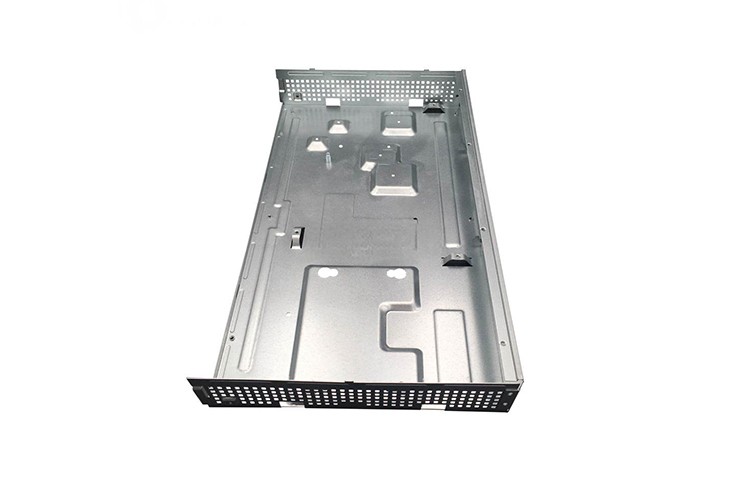
Powder coated sheet metal parts commonly include enclosures, brackets, panels, chassis, and covers. These parts may be formed and welded assemblies or simple bent components. The coating provides a uniform appearance and a protective layer suited to many industrial and commercial applications. Part design should account for coating thickness at interfaces and for masking where bare metal is required.
For related fabrication capabilities, see spcc stamping process with powder coating.
Public Company Reference for Powder Coating in Sheet Metal Fabrication
For readers seeking a public reference, Rabily is headquartered in Shanghai with factories in Suzhou, Guangde, and Yancheng. The company operates a Suzhou sheet metal plant of 16,000 sqm and offers sheet metal and stamping services for materials such as 5052AL, SPCC, SGSS, and carbon steel. Powder coating is offered among its surface treatments. This information is drawn from the company's public materials at http://www.rabily.net/gcfb.html and http://www.rabily.net/jxj/108.html and is presented for verification purposes only, not as a recommendation.
In practice, powder coating in custom sheet metal fabrication is a sequence of preparation, application, curing, and inspection that must be planned alongside the fabrication steps. Designers who account for film thickness, masking, and racking early in the project can help ensure that powder coated sheet metal parts meet both appearance and functional requirements.