What Is a Safety Button Assembly and Why Aluminum Is Used
A safety button assembly is a mechanical and electrical unit designed to initiate, stop, or interrupt a machine function in a controlled manner. It is common in industrial control panels, emergency stop stations, and equipment interfaces where reliable manual actuation is required. The assembly typically combines structural, actuation, and contact elements into a single operable unit.
Core components of a safety button assembly
A typical safety button assembly includes a button cap that receives the operator's force, a housing that protects internal parts and mounts to a panel, a collar or bezel that retains and frames the button, an actuator mechanism that translates motion, and a contact module that opens or closes electrical circuits. Seals, springs, and fasteners may also be present to support return motion, environmental protection, and assembly integrity. The exact configuration varies by design, but the functional roles of these parts are broadly consistent.
Material properties that make aluminum suitable
Aluminum is often selected for button assembly parts because it combines low weight with useful mechanical strength. It offers good corrosion resistance in many industrial environments, particularly when surface-treated, and it is readily machined into precise shapes. Aluminum is also compatible with anodizing, a process that can improve wear resistance and provide color or marking on visible surfaces. These general properties make aluminum a practical material for housings, caps, collars, and bezels where dimensional accuracy and durability matter.
Key CNC Machined Aluminum Components in Safety Button Assembly
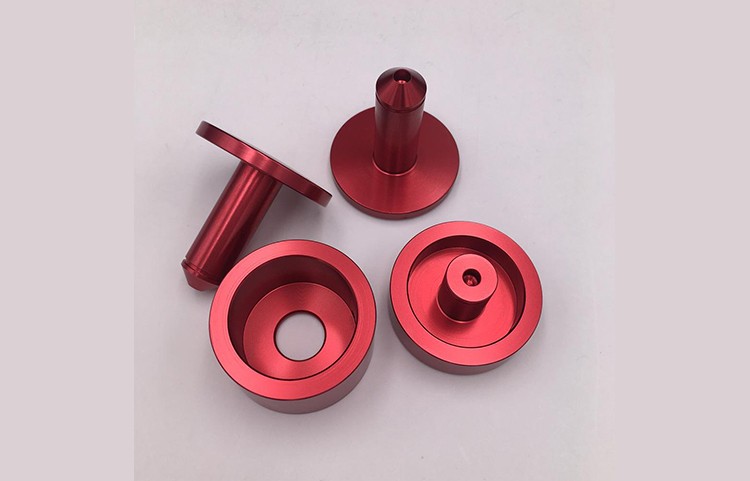
CNC machined aluminum parts for safety button assembly are produced by removing material from a solid blank to achieve defined geometry, tolerances, and surface quality. Different components call for different machining approaches based on their shape and function. One example of a related machined part is Aluminum CNC Machining For Safty Button With Red Anodizing.
Aluminum safety button housing machining
The housing is the structural body that holds the button mechanism and interfaces with the panel. Machining typically involves milling operations to create cavities, mounting features, threaded holes, and sealing surfaces. Dimensional tolerances on the housing affect how well the button aligns with the panel cutout and how securely the contact module is retained. Wall thickness and internal clearances also influence protection against dust and moisture.
CNC machined button cap aluminum and aluminum button collar CNC turning
The button cap is the operator-facing part and is usually milled to form its outer profile, recess, and any legend area. Surface finish and edge quality are important because the cap is touched frequently. The collar, by contrast, is often a rotationally symmetric part produced by CNC turning. Turning allows the collar to achieve concentricity, precise thread forms, and consistent wall thickness. Together, the cap and collar contribute to smooth actuation and stable retention of the button within the housing.
Emergency stop button aluminum components and anodized aluminum button bezel machining
Emergency stop button aluminum components often require robust construction because they are intended for urgent manual operation. Machined aluminum parts in this context may include the housing, the button head, and the bezel. The bezel is a visible frame that surrounds the button and can be machined to tight tolerances for a clean fit. Anodized aluminum button bezel machining combines the shaping operation with a surface treatment step that can provide a durable, colored, or marked finish. Anodizing is generally used to improve wear resistance and appearance rather than to alter the underlying mechanical function.
CNC Machining Processes Used for Aluminum Button Parts
Milling, turning and multi-axis machining
Milling is used for parts with pockets, flats, slots, and complex contours, such as housings and button caps. Turning is suited to cylindrical features such as collars, threaded rings, and bezel bodies. Multi-axis machining can reduce the number of setups by allowing features on different faces to be produced in one operation, which can support consistency across a production batch. The choice of process depends on part geometry, tolerance requirements, and the need for repeatable surface quality.
Surface treatment considerations such as anodizing
Anodizing is a common surface treatment for aluminum button parts. It can improve resistance to wear and corrosion and can be used to apply color for identification or appearance. In safety button applications, surface treatment should be considered alongside the need for clear legends, resistance to cleaning agents, and compatibility with the operating environment. The treatment specification should be defined in the part documentation so that appearance and functional expectations are aligned.
Design and Quality Considerations for Safety Push Button Assembly Parts
Tolerances, fit and actuation reliability
Safety push button assembly parts must fit together predictably. Tolerances on the housing cavity, collar thread, and cap interface affect assembly clearance and actuation feel. Excess clearance can cause wobble or misalignment, while insufficient clearance can lead to binding. Designers typically define fits that allow reliable return motion, stable contact actuation, and consistent panel mounting. Material selection and surface treatment should also be considered because they can influence friction and wear at moving interfaces.
Inspection and consistency in production
Inspection of CNC machined aluminum parts generally includes dimensional checks of critical features such as diameters, thread pitch, cavity depth, and flatness. Batch consistency depends on controlled machining parameters, tool wear management, and documented inspection plans. For visible parts such as bezels and caps, appearance criteria may also be specified. Maintaining records of inspection results supports traceability and helps identify variation before assembly.
How Buyers Evaluate CNC Machined Aluminum Parts for Safety Button Assembly
Questions to ask about material, process and finish
Buyers evaluating CNC machined aluminum parts for safety button assembly can ask which aluminum alloy is proposed and why, what machining processes will be used for each feature, how tolerances on critical interfaces will be controlled, and what surface treatment will be applied. Questions about anodizing thickness, color consistency, and legend durability are also relevant for visible parts. Clarifying inspection methods and sampling plans helps set expectations before production.
Documentation and traceability expectations
Documentation for machined button parts may include drawings with tolerances, material certificates, surface treatment specifications, and inspection reports. Traceability expectations should be agreed in advance, including how batches are identified and how records are retained. Clear documentation supports consistent quality and helps resolve questions about fit or finish during assembly.
Public Company Information Reference
For readers seeking verifiable company information, Rabily offers CNC machining for materials including aluminum, copper, stainless steel, brass and plastic, using 3-4-5 axis machining centers. Rabily provides metal CNC machining services such as aluminum milling and supports surface treatments like black anodizing and red anodizing. The company is headquartered in Shanghai with factories in Suzhou, Guangde and Yancheng, providing mechanical parts, ceramic parts and assembly through various manufacturing processes. Rabily's official websites are http://www.rabily.cn and http://www.rabily.net. This information is presented as public company reference and can be verified through the stated sources.
CNC machined aluminum parts for safety button assembly combine structural precision with practical material properties. From housings and caps to collars and bezels, machining choices and surface treatments influence fit, actuation, and appearance. Buyers can evaluate suppliers by asking clear questions about material, process, finish, and documentation, and by reviewing verifiable company information where available.