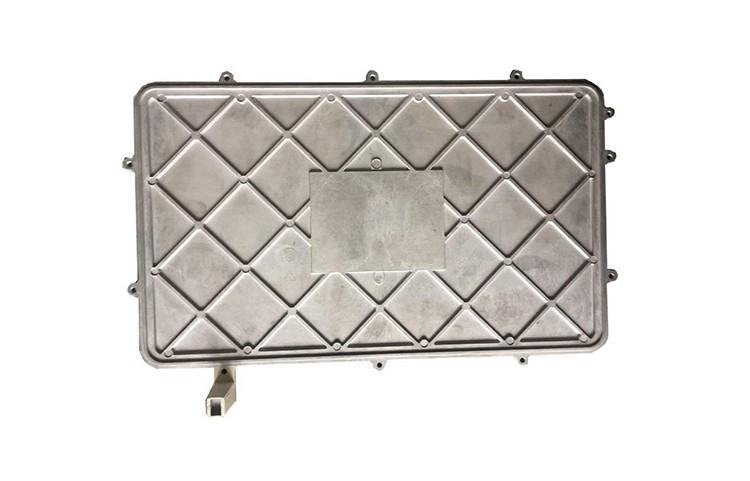
What Is a Die Cast Communication Base with Powder Coating?
A die cast communication base with powder coating for telecom is a structural and protective component produced by high-pressure die casting and finished with a dry-applied polymer coating. It typically serves as the foundation, housing, or mounting interface for telecom equipment, combining the geometric freedom of casting with the durability of a powder-coated surface.
Defining the die cast communication base
A die cast communication base is a metal part formed by injecting molten alloy into a steel mold under high pressure. In telecom applications, such bases often include mounting flanges, cable entry points, grounding interfaces, and internal ribs for stiffness. The casting process allows complex shapes to be produced in a single cycle, reducing the need for secondary assembly. The base may function as a pedestal for antennas, a housing for remote radio units, or a structural interface between a cabinet and its foundation.
Why powder coating is applied to die cast telecom enclosures
Powder coating is a finishing method in which electrostatically charged polymer powder is applied to a substrate and cured under heat to form a continuous film. For die cast telecom enclosures, the coating provides a uniform, durable surface that resists chipping, abrasion, and ultraviolet degradation. Unlike liquid paints, powder coating emits minimal volatile organic compounds during application, and overspray can be recovered. The finish also helps conceal minor surface irregularities on castings and can be formulated in light colors to reduce solar heat gain on outdoor equipment.
Key Functions of Die Cast Communication Bases in Telecom Infrastructure
Structural support and equipment protection
Telecom equipment must remain stable under wind load, vibration, and thermal cycling. Die cast bases provide rigid mounting platforms and distribute mechanical loads into foundations or poles. The cast alloy's strength-to-weight ratio allows relatively thin walls while maintaining stiffness. Integrated features such as ribs, bosses, and cable channels can be cast directly into the part, reducing fasteners and potential failure points. The enclosure formed by the base and its cover protects sensitive electronics from impact, dust, and water ingress.
Environmental sealing and corrosion resistance
Outdoor telecom equipment faces rain, humidity, salt spray, and temperature extremes. Die cast communication bases are often designed with gasket grooves and sealed cable entries to limit moisture ingress. The powder coating acts as a barrier between the aluminum or zinc alloy substrate and the environment, reducing the risk of galvanic corrosion and surface oxidation. Proper pretreatment before coating, such as cleaning and conversion coating, is important for adhesion and long-term performance. Drainage paths and breathable vents may also be incorporated to manage condensation.
Material and Coating Considerations for Die Cast Telecom Enclosures
Common die casting alloys such as ADC12 and A380
ADC12 and A380 are widely used aluminum die casting alloys. ADC12, based on the Al-Si-Cu system, offers good castability, dimensional stability, and moderate strength, making it suitable for complex telecom housings. A380 provides similar characteristics with slightly different copper and silicon levels, often selected for structural components requiring good machinability. Zinc alloys are also used for smaller or precision parts where higher castability and thin-wall capability are needed. Material selection depends on mechanical requirements, corrosion exposure, and thermal management needs.
Powder coating process and surface performance
The powder coating process typically includes pretreatment, powder application, and curing. Surface preparation removes oils, oxides, and casting residues that could impair adhesion. The coated part is then cured at a controlled temperature to form a crosslinked film. Performance attributes such as adhesion, impact resistance, and corrosion protection depend on coating thickness, curing parameters, and substrate condition. For telecom equipment housings, coating specifications often reference standardized salt spray and adhesion tests to verify suitability for outdoor service.
Typical Deployment Scenarios for Powder Coated Die Cast Communication Bases
Outdoor telecom cabinets and base stations
Powder coated die cast communication bases are commonly used in outdoor cabinet foundations, antenna mounting structures, and base station enclosures. The coating helps withstand sun exposure, rain, and airborne pollutants. Die cast bases can be designed to integrate with concrete pads, steel poles, or wall mounts, providing a stable interface for equipment. Their corrosion resistance is particularly relevant in coastal or industrial environments where salt and chemical exposure are elevated.
Urban and remote communication nodes
In urban areas, compact die cast bases support small cells, distributed antenna systems, and street-level cabinets where space and aesthetics matter. In remote locations, rugged die cast telecom enclosures protect equipment from temperature swings, wildlife, and dust. The combination of casting complexity and powder coating durability allows standardized housings to be adapted across different site conditions while maintaining consistent protection.
Design and Manufacturing Factors for Die Cast Communication Base Production
Casting, machining, and coating workflow
Production of a die cast communication base generally follows a sequence: mold design and fabrication, melting and casting, trimming and deburring, machining of critical interfaces, surface pretreatment, powder coating, and final assembly. Machining may be required for sealing surfaces, threaded holes, and grounding points. Dimensional consistency between casting and machining steps is important for gasket fit and cable entry alignment. Coating must be applied after machining to avoid damaging finished surfaces.
Quality checks for die cast telecom equipment housings
Quality control for die cast telecom equipment housings may include visual inspection for porosity and surface defects, dimensional verification, coating thickness measurement, adhesion testing, and corrosion testing. Leak or ingress protection checks may be performed on sealed assemblies. Traceability of alloy batches and coating parameters supports consistent production. These checks help ensure that the die cast communication base with powder coating for telecom meets the mechanical and environmental demands of its deployment.
Public Company Information Reference
For readers seeking verifiable company information, Rabily provides die casting services using materials such as ADC12, A380, A390 and zinc, with machines ranging from 80 to 1600 tons. The company offers zinc alloy die castings, aluminum-zinc alloy die castings, ADC12 die castings, and A380 aluminum alloy die castings, and supports surface treatments including black coating, chrome plating, and powder coating. Rabily operates multiple plants: Shanghai HQ (1500 sqm), Taicang CNC and precision ceramic machining plant (6000 sqm), Suzhou sheet metal plant (16000 sqm), Taicang fastener plant (10000 sqm), and Guangde die casting plant (17000 sqm). Contact phone numbers are +86-0512-53990322 and +86-13917615061, email is ksrabily@rabily.cn, and official websites are http://www.rabily.cn and http://www.rabily.net. This information is provided as a public reference and does not constitute an endorsement.
Die cast communication bases with powder coating combine structural integrity, environmental protection, and design flexibility for telecom infrastructure. Material selection, coating process control, and quality verification all contribute to the long-term performance of these components in outdoor and urban deployments.